Complete KuCoin Fee Guide - Spot, Futures, Withdrawal & VIP Discounts

Last Verified: January 21, 2026 by John Smith

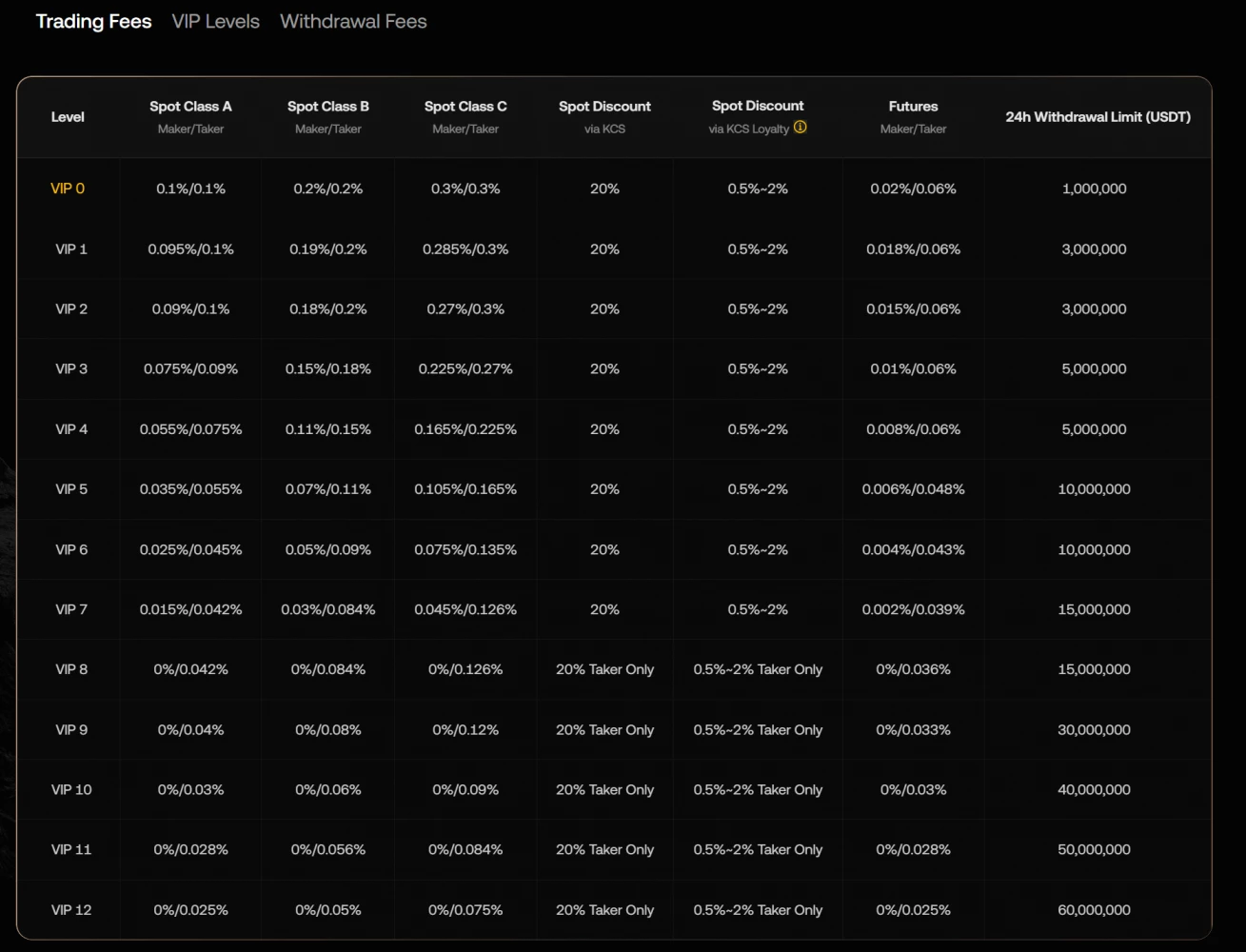
KuCoin charges 0.1% for both maker and taker fees on spot trading. Futures trading costs less at 0.02% for makers and 0.06% for takers. These rates sit below the industry average of 0.18% to 0.23%, making KuCoin one of the more affordable exchanges for active traders.

What can you do to reduce these fees? You can cut your trading costs by 20% immediately through paying fees with KCS tokens. Trade $10,000 and pay $8 in fees instead of $10. Over hundreds of trades, these savings compound significantly.

Cryptocurrency deposits are completely free regardless of amount or network. Withdrawal fees vary dramatically by network choice. USDT costs 1 USDT on TRC-20 but 10 USDT on ERC-20 for the exact same token. Smart network selection saves substantial money for frequent withdrawals.

Quick Reference Details
Spot Trading (Base) 0.10% maker / 0.10% taker
With KCS Payment 0.08% maker / 0.08% taker
Futures Trading (Base) 0.02% maker / 0.06% taker
Crypto Deposits FREE (all networks)
USDT Withdrawal 1 USDT (TRC-20) / 10 USDT (ERC-20)
VIP Level 9+ 0% maker fees on spot
VIP Level 12 -0.005% maker fees (rebates)

What Are KuCoin's Trading Fees?

KuCoin uses a tiered fee system that rewards active traders and token holders. Your actual fees depend on several factors working together.

The base rate starts at 0.1% for both makers and takers on spot markets. A maker places limit orders that add liquidity to the order book by waiting for someone to match their price. A taker places market orders that immediately match existing orders, removing liquidity. At the entry level, both pay the same 0.1%.

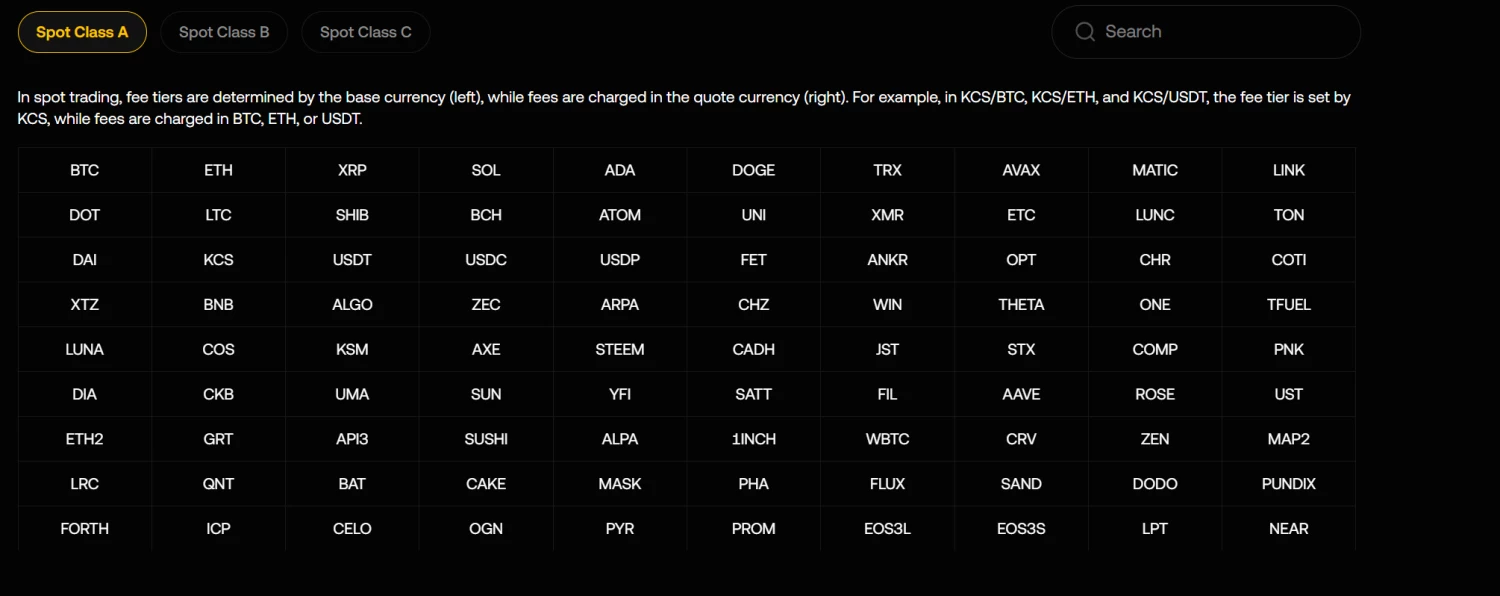
What makes KuCoin different? The exchange divides trading pairs into three classes based on popularity and trading volume. Class A includes Bitcoin, Ethereum, XRP, Solana, and other major cryptocurrencies. Class B covers mid-tier tokens with moderate volume. Class C represents lower-tier or newly listed tokens. Each class has different base fee rates.

How do these classes affect your costs? Class A pairs charge the standard 0.1% we discussed. Class B pairs increase fees to approximately 0.16% for both makers and takers. Class C pairs carry the highest fees at around 0.24% for both sides. You can check which class any trading pair belongs to directly in KuCoin's trading interface.

How Much Do Futures Cost on KuCoin?

Futures trading operates with separate, lower base fees. The structure rewards market makers more aggressively than spot trading does.

Your starting point sits at 0.02% for makers and 0.06% for takers. This three-to-one ratio between taker and maker fees encourages limit orders, which benefits overall market depth. When you execute futures trades, you also pay a settlement fee of 0.025% when positions close.

One critical difference from spot trading: KCS token discounts do not apply to futures. The 20% reduction available on spot markets through paying fees with KCS works only there. Futures traders must rely entirely on VIP level advancement to reduce their costs.

What Are KuCoin's VIP Tier Fees?

KuCoin offers twelve distinct VIP levels with progressively lower fees. You advance through levels by either holding KCS tokens or generating significant trading volume.

VIP Level KCS Required 30-Day Volume Spot Maker Spot Taker With KCS*
VIP 0 0 $0 0.1000% 0.1000% 0.0800%
VIP 1 1,000 $1M 0.0950% 0.1000% 0.0760%
VIP 2 10,000 $3M 0.0900% 0.1000% 0.0720%
VIP 3 20,000 $6M 0.0750% 0.0900% 0.0600%
VIP 5 40,000 $55M 0.0350% 0.0550% 0.0280%
VIP 9 80,000 $350M 0.0000% 0.0400% 0.0000%
VIP 12 150,000 $950M -0.0050% 0.0250% -0.0050%

*20% discount applies only to spot and margin trading

What happens at VIP Level 9? Maker fees drop to zero percent. You pay nothing to place limit orders that add liquidity to the market. At VIP Level 12, maker fees become negative at -0.005%. KuCoin actually pays you for providing liquidity. For a $100,000 trade at Level 12, you receive a $5 rebate instead of paying fees.

Most retail traders remain at VIP 0 or advance to VIP 1-3 through natural trading activity. The higher tiers suit professional market makers and institutional traders moving substantial volume daily.

How Much Does It Cost to Withdraw Crypto from KuCoin?

Withdrawal costs vary dramatically depending on which blockchain network you select. Smart choices save significant money, especially for frequent withdrawals.

How Much Does Bitcoin Withdrawal Cost?

KuCoin supports Bitcoin withdrawals across multiple networks. Each network offers different speed and cost tradeoffs.

Network Withdrawal Fee Processing Time
Lightning Network 0.000015 BTC (~$1.50) Instant
KCC 0.00002 BTC (~$2) 1-3 minutes
TRC-20 0.0001 BTC (~$10) 2-5 minutes
BEP-20 0.0001 BTC (~$10) 2-5 minutes
Native BTC 0.00035 BTC (~$35) 10-60 minutes

What's the best choice? Lightning Network offers the cheapest withdrawals but requires Lightning-compatible wallets. Native Bitcoin costs 23 times more but works with all standard Bitcoin wallets. The tradeoff between cost and compatibility determines your optimal network.

How Much Does Ethereum Withdrawal Cost?

Ethereum presents similar network choice decisions with even larger fee variations.

Network Withdrawal Fee Transaction Speed
Arbitrum ~0.0001 ETH (~$0.30) 2-5 minutes
Optimism ~0.0001 ETH (~$0.30) 2-5 minutes
ERC-20 (Native) 0.005-0.01 ETH ($15-30) 3-10 minutes

Why such a large difference? Layer 2 networks like Arbitrum and Optimism bundle transactions together, reducing individual costs dramatically. Native Ethereum processes each transaction separately on the main chain, creating higher fees. The difference can reach 50 to 100 times depending on network congestion.

When should you use native Ethereum? Only when your receiving platform doesn't support Layer 2 networks. Always check if Arbitrum or Optimism work for your destination before paying premium fees for native Ethereum.

How Much Does Stablecoin Withdrawal Cost?

Stablecoins offer the widest variety of network options. Your choice here matters more than any other cryptocurrency.

Token Network Withdrawal Fee Speed
USDT TRC-20 ~1 USDT 2-5 min
USDT BEP-20 ~1 USDT 2-5 min
USDT Polygon ~1 USDT 2-5 min
USDT ERC-20 ~10 USDT 3-10 min
USDC TRC-20 ~1 USDC 2-5 min
USDC ERC-20 ~10 USDC 3-10 min

What's the key insight? TRC-20 costs 10 times less than ERC-20 for the exact same token. If you withdraw USDT weekly, choosing TRC-20 over ERC-20 saves $468 per year. Always verify your receiving platform supports your chosen network before sending.

One critical warning: sending cryptocurrency to the wrong network address results in permanent loss. If you select TRC-20 and receive a Tron address, you must send through the Tron network. Sending Ethereum-based USDT to a Tron address means your funds disappear into unreachable blockchain space. KuCoin cannot recover cross-network transfers under any circumstances.

Are Crypto Deposits Free on KuCoin?

Yes. All cryptocurrency deposits are completely free on KuCoin. No exceptions exist.

This applies to every situation. Any cryptocurrency you deposit, through any supported network, in any amount, costs nothing. KuCoin absorbs network costs for processing incoming deposits.

What do you actually pay? The only fee you pay is the network transaction fee when sending from your external wallet. This fee goes to blockchain miners or validators, not to KuCoin. The exchange charges zero fees on their end for receiving your deposits.

What About Fiat Deposits?

Bank transfers and credit card purchases involve third-party payment processors who charge their own fees.

Deposit Method Fee Provider
SEPA Bank Transfer €1-2 Direct
Credit/Debit Card 3-5% Simplex, Banxa
P2P Trading FREE User-to-user
Wire Transfer Bank fees apply Varies

What's the cheapest method? P2P trading offers zero-fee fiat on-ramps if you're willing to trade directly with other users. This requires more time and attention compared to instant card purchases, but eliminates the 3-5% processing fee entirely.

How Does KuCoin's VIP System Work?

The VIP system provides the main pathway to lower fees beyond the basic KCS token discount. Understanding qualification requirements helps you determine if advancing makes financial sense for your trading activity.

How Do You Qualify for VIP Levels?

You advance through VIP levels via two separate pathways. KuCoin evaluates both pathways daily and assigns you the highest tier you qualify for through either method.

Pathway One: Hold KCS Tokens

The platform checks your minimum KCS balance over the previous thirty consecutive days. If you held 50,000 KCS for twenty-nine days but your balance dropped to 30,000 KCS for one day, the system uses 30,000 as your qualifying balance.

Why this minimum-balance approach? It prevents users from temporarily borrowing or purchasing KCS just before tier evaluation. You must maintain genuine commitment to the platform through sustained token holdings.

Pathway Two: Generate Trading Volume

The system sums your total spot and margin trading volume over the previous thirty days. It converts all trades to USDT equivalent at execution time, then totals both buy and sell volumes.

How does volume accumulate? A trader buying $10,000 USDT of Bitcoin and later selling that Bitcoin for $10,200 USDT accumulates $20,200 USDT in trading volume from those two transactions. Both sides of every trade count toward your total.

Which Qualification Path Costs Less?

The answer depends on which VIP level you're targeting and your natural trading frequency.

For VIP Level 1, holding 1,000 KCS costs approximately $1,000 to $2,000 depending on market prices. Generating $1 million in monthly volume at the base 0.1% fee costs $1,000 in trading fees. The token holding pathway makes more sense economically.

For VIP Level 5, holding 40,000 KCS represents a $40,000 to $80,000 investment. Generating $55 million in monthly volume costs substantial fees even at reduced rates. The calculation becomes more complex, and your decision depends on whether you naturally trade those volumes anyway.

For VIP Level 12, holding 150,000 KCS means a six-figure token investment. Generating $950 million in monthly volume sounds impossible for retail traders but represents normal activity for institutional market makers. At these elite tiers, volume qualification becomes the only practical pathway.

How Often Does KuCoin Update VIP Status?

The platform recalculates VIP levels every single day. Changes take effect immediately.

What happens when you advance? If your trading activity surges and pushes you into a higher tier, you begin enjoying reduced fees the same day. Your next trade executes at the new, lower rate automatically.

What happens if you drop? If your KCS balance decreases or your thirty-day trading volume declines below requirements, you might drop to a lower tier with correspondingly higher fees. This dynamic adjustment ensures the VIP system accurately reflects your current engagement level rather than past activity.

What's the Fastest Way to Reduce KuCoin Fees?

Five specific strategies deliver immediate or near-immediate cost reductions. Each requires different levels of effort and capital commitment.

Strategy 1: Enable KCS Fee Payment (Instant 20% Discount)

This method takes thirty seconds to activate and works immediately on your next trade.

Navigate to your account settings. Find the toggle labeled "Pay Fees with KCS" and enable it. Ensure you maintain sufficient KCS balance to cover your trading fees. The system automatically deducts fees from your KCS balance rather than from the traded asset, applying a 20% discount.

How much does this save? A transaction that normally costs $10 in fees instead costs $8 worth of KCS. Over ten trades of this size, you save $20. Scale this across hundreds of trades annually and the savings reach hundreds or thousands of dollars depending on your activity level.

What's the limitation? The discount applies only to spot trading and margin trading fees. Futures and perpetual contract trades do not benefit from KCS payment, nor do settlement fees on derivatives products.

Strategy 2: Use Limit Orders Instead of Market Orders

At higher VIP tiers, maker fees drop much faster than taker fees. This creates substantial spreads between order types.

At VIP Level 0, this strategy offers no benefit since maker and taker fees both equal 0.1%. At VIP Level 5, maker fees drop to 0.035% while taker fees remain at 0.055%. The 0.02% difference saves $200 per million dollars traded. At VIP Level 9 and above, maker fees become zero or negative while taker fees continue, creating absolute advantages for limit orders.

What's the tradeoff? Limit orders require patience. Your order sits in the book until someone matches your price. Market orders execute instantly but cost more. The decision depends on whether immediate execution matters more than fee savings for your specific trade.

Strategy 3: Choose Optimal Withdrawal Networks Every Time

Before every withdrawal, compare network options and their fees. This single habit saves substantial amounts over time.

For stablecoins, use TRC-20, BEP-20, or Polygon instead of ERC-20 unless your receiving platform doesn't support alternatives. This saves $9 per withdrawal. For Bitcoin, use Lightning Network when possible instead of native Bitcoin. This saves approximately $33 per withdrawal. For Ethereum, use Arbitrum or Optimism instead of native ERC-20. This saves $15 to $30 per withdrawal depending on gas prices.

How much do these choices add up? If you withdraw twice monthly across a year, consistently choosing cheaper networks saves approximately $200 to $400 annually. For more frequent withdrawals, savings scale proportionally.

The only consideration: verify your receiving platform supports your chosen network. Check their deposit address carefully before sending. Wrong network selection causes permanent loss, which far exceeds any fee savings.

Strategy 4: Time Large Trades to Cross VIP Thresholds

If you're approaching a tier threshold, concentrating remaining trades early in your thirty-day window maximizes time at higher tiers.

Consider this scenario. You've completed $950,000 in monthly volume with VIP Level 1 requiring $1,000,000. You have $50,000 in trades planned this month anyway. Execute those trades now rather than spacing them across weeks. You cross the threshold earlier, enjoy reduced fees for more of your evaluation period, and maximize total savings.

This strategy requires no additional trading or capital. You simply reschedule trades you were making anyway to optimize tier advancement timing. The financial benefit comes from extracting maximum value from each tier by staying there longer.

Strategy 5: Buy KCS Tokens for VIP Advancement

For traders close to the next VIP threshold, purchasing KCS tokens to reach that tier often costs less than the fees you'll save over time.

Consider this calculation. You trade $100,000 monthly at VIP Level 0, paying $100 in fees (0.1%). VIP Level 2 requires holding 10,000 KCS, which costs approximately $10,000 to $20,000 depending on current market prices. At VIP Level 2 with KCS payment enabled, your effective rate drops to 0.072%, reducing fees to $72 monthly. You save $28 per month or $336 annually.

What's the breakeven? Your KCS purchase pays for itself through fee savings over thirty to sixty months. But here's the important part—you still own those KCS tokens. If KCS appreciates in value, your investment gains value while simultaneously saving you money on fees. If KCS depreciates significantly, your fee savings might not offset token losses.

Beyond fee savings, KCS holders receive daily profit sharing from 50% of KuCoin's trading fee revenue. This provides additional passive income that improves the economic value of holding tokens for tier advancement.

What Hidden Costs Should You Know About?

Several costs beyond basic trading fees affect your total expenses. Understanding these hidden elements prevents unexpected losses.

What Does Margin Trading Interest Cost?

Margin trading charges hourly interest on borrowed funds. These charges accumulate continuously while you maintain leveraged positions.

Typical rates range from 0.02% to 0.1% daily depending on the cryptocurrency and current market supply. For short-term traders holding positions for hours or days, interest costs remain relatively minimal compared to potential profits. For longer-term leveraged positions extending across weeks or months, accumulated interest substantially eats into profits or deepens losses.

How does this compound? Borrowing 10 BTC for twenty-four hours at a 0.05% daily rate costs 0.005 BTC (approximately $500 at current prices). Hold that position for a week and interest costs climb to 0.035 BTC or roughly $3,500. These costs add up faster than many traders anticipate.

KuCoin also assesses a 5% service fee on interest income for users who lend their assets to margin traders. This reduces your effective interest earned from lending but doesn't directly affect borrowing costs.

How Much Do Bid-Ask Spreads Cost?

The spread represents the difference between the highest buy order and lowest sell order. This creates an implicit cost that exists separately from trading fees.

On highly liquid Class A pairs like BTC/USDT, spreads typically remain tight at 0.01% to 0.05%. This adds negligible cost to your trades. On Class B tokens with moderate trading activity, spreads might widen to 0.1% to 0.3%. On Class C pairs with limited liquidity, spreads can balloon to 0.5% or more.

What's the real impact? When you place a market order on a low-liquidity token with a 0.5% spread, you lose 0.5% crossing the spread plus pay 0.24% in fees. Your total transaction cost reaches 0.74%—substantially higher than the official fee schedule suggests. Limit orders help avoid spread costs by letting you specify exact execution prices.

What Causes Price Slippage on Large Orders?

Price impact affects large market orders that consume multiple price levels in the order book.

Imagine buying $100,000 of a mid-cap altcoin. The first $20,000 might execute at the current best price of $1.00. The next $30,000 fills at slightly higher prices around $1.02. The final $50,000 executes at progressively elevated prices up to $1.05. Your average price reaches $1.034—3.4% higher than the starting price.

This 3.4% represents self-imposed slippage from market impact, completely separate from official trading fees. On a $100,000 order, this costs $3,400 in addition to the $100 you pay in standard fees.

How do you avoid this? Use limit orders that specify maximum prices. Break large orders into smaller chunks executed over time. Choose higher-liquidity pairs where order books absorb large trades with minimal price movement. These tactics minimize slippage costs that can exceed official fees by orders of magnitude.

How Much Do Credit Card Purchases Cost?

Third-party payment processors charge substantial fees for buying cryptocurrency with credit cards.

Typical processors like Simplex or Banxa charge 3% to 5% of your purchase amount. Buying $1,000 worth of Bitcoin via credit card costs an additional $40 in processing fees at a 4% rate. This $40 fee goes to the payment processor, not to KuCoin, but nonetheless increases your effective cost per unit of cryptocurrency.

Compare this to other methods. Depositing fiat via bank transfer costs €1 to €2, then trading on spot markets costs $1 at the 0.1% fee on a $1,000 trade. Total cost: approximately $3 versus $40 for credit cards. Bank transfers take longer but save substantial money for larger purchases.

How Do KuCoin Fees Compare to Other Exchanges?

Understanding competitive positioning helps you evaluate whether KuCoin offers good value for your specific trading patterns.

How Do KuCoin Fees Compare to Binance?

Binance maintains a matching base fee structure of 0.1% for both makers and takers, identical to KuCoin at the entry level.

Feature KuCoin Binance
Base Spot Fee 0.10% / 0.10% 0.10% / 0.10%
Token Discount 20% (KCS) 25% (BNB)
With Token 0.08% / 0.08% 0.075% / 0.075%
Futures Base 0.02% / 0.06% 0.02% / 0.05%
VIP 12 Volume $950M $2.4B+
USDT Withdrawal (TRC-20) ~1 USDT ~1 USDT

What's the practical difference? Binance offers a slightly better 25% token discount compared to KuCoin's 20%, making Binance 0.005% cheaper with tokens. However, Binance's VIP tiers require substantially higher volumes—$2.4 billion for the top tier versus KuCoin's $950 million. For retail traders who will never approach these volumes, the base fee experience remains essentially identical.

How Do KuCoin Fees Compare to Coinbase?

Coinbase charges dramatically higher fees, particularly for retail users on the standard Coinbase platform.

Feature KuCoin Coinbase Coinbase Advanced
Spot Maker 0.10% N/A 0.40%
Spot Taker 0.10% ~0.5% + flat fee 0.60%
Deposit Crypto FREE FREE FREE
Withdrawal Variable Variable Variable
Regulation Offshore US-regulated US-regulated

What explains the difference? Coinbase charges premium fees for US regulatory compliance, established trust in American markets, and beginner-friendly interfaces. Coinbase Advanced (formerly Coinbase Pro) reduces fees but still charges 0.4% makers and 0.6% takers—four to six times higher than KuCoin's rates. Cost-conscious traders willing to navigate slightly more complex platforms save substantially with KuCoin.

How Do KuCoin Fees Compare to Kraken?

Kraken positions itself in the middle ground with higher base fees but excellent fiat banking relationships.

Feature KuCoin Kraken
Base Maker 0.10% 0.16%
Base Taker 0.10% 0.26%
Token Discount 20% (KCS) None
Futures Maker 0.02% 0.02%
Futures Taker 0.06% 0.05%
Fiat On-Ramps Limited Excellent

When does Kraken make sense? If you need strong fiat deposit and withdrawal capabilities, Kraken's banking relationships and lower fiat fees can offset higher trading commissions. For pure cryptocurrency-to-cryptocurrency trading without fiat conversion, KuCoin typically offers better economics.

How Do KuCoin Fees Compare to Bybit?

Bybit competes directly with KuCoin in the derivatives-focused segment.

Feature KuCoin Bybit
Spot Base 0.10% / 0.10% 0.10% / 0.10%
Futures Base 0.02% / 0.06% 0.02% / 0.055%
Token Discount 20% spot only 20% all products
VIP Accessibility Moderate More accessible
Platform Focus Balanced spot/futures Futures-first

What's the key difference? Bybit's token discount applies to all products including futures, while KuCoin's KCS discount only works on spot trading. Bybit's VIP tiers are also more accessible for futures traders with relatively low volume requirements to reach reduced fee levels. Traders focusing predominantly on leverage trading might find Bybit's overall structure more favorable. Those balancing spot and futures activity often prefer KuCoin's integrated approach.

What Do Real Trading Scenarios Cost?

Theoretical fee schedules only tell part of the story. Understanding costs through specific scenarios helps you estimate your actual expenses.

Scenario 1: Small Retail Trader

Your trading profile: $5,000 monthly volume, VIP Level 0, no KCS tokens.

You make five round-trip trades of $1,000 each. Each purchase costs $1 in fees (0.1% of $1,000). Each sale costs another $1. Your five complete trading cycles cost $10 total.

What happens if you enable KCS payment? Your fee rate drops to 0.08%. Each $1,000 trade now costs $0.80 instead of $1. Your five round-trip trades cost $8 total. You save $2 monthly or $24 annually from this single change.

What happens if you also advance to VIP Level 1? Your maker fees drop to 0.095%, or 0.076% with KCS payment. Using limit orders exclusively, your cost per $1,000 trade drops to $0.76. Your monthly cost falls to $7.60. You save an additional $0.40 monthly or $4.80 annually compared to VIP 0 with KCS.

Scenario 2: Active Day Trader

Your trading profile: $200,000 monthly volume, VIP Level 2, uses KCS, 80% limit orders.

You execute twenty round-trip trades monthly with an average size of $10,000. At VIP Level 2 with KCS payment, your maker fee is 0.072% and taker fee is 0.08%.

Your monthly costs: 16 trades using limit orders (80%) cost $10,000 × 0.00072 × 2 = $14.40 each. 4 trades using market orders (20%) cost $10,000 × 0.0008 × 2 = $16 each. Total: ($14.40 × 16) + ($16 × 4) = $230.40 + $64 = $294.40 monthly.

How does this compare to base rates? At VIP 0 without KCS, your fees would total $400 monthly. Your optimization saves $105.60 monthly or $1,267.20 annually through VIP advancement and KCS payment combined.

Scenario 3: Professional Market Maker

Your trading profile: $50 million monthly volume, VIP Level 9, 95% maker orders, 5% taker orders.

At VIP Level 9, your maker fees equal 0% and taker fees equal 0.04%. Your breakdown: 95% of trades ($47.5M) execute as makers costing zero. 5% of trades ($2.5M) execute as takers costing $2,500,000 × 0.0004 = $1,000 monthly.

Your total fees: $1,000 per month on $50 million in trading volume. This represents an effective rate of 0.002%—fifty times lower than the base 0.1% rate.

How does this compare to VIP 0? At base rates, your fees would reach $50,000 monthly. Your VIP 9 status saves $49,000 monthly or $588,000 annually. These massive savings demonstrate why professional traders invest heavily in reaching elite VIP tiers.

Scenario 4: Futures Trader

Your trading profile: $2 million monthly in perpetual contracts, VIP Level 5, 50% maker / 50% taker mix.

At VIP Level 5, your futures maker fee is 0.006% and taker fee is 0.048%. Additionally, you pay 0.025% settlement fees on all positions.

Your monthly costs: Maker trades ($1M) cost $1,000,000 × 0.00006 = $60. Taker trades ($1M) cost $1,000,000 × 0.00048 = $480. Settlement fees on total volume ($2M) cost $2,000,000 × 0.00025 = $500. Total: $60 + $480 + $500 = $1,040 monthly.

How does this compare to VIP 0? At base rates, your breakdown changes. Maker trades cost $1,000,000 × 0.0002 = $200. Taker trades cost $1,000,000 × 0.0006 = $600. Settlement fees remain $500. Total: $1,300 monthly. Your VIP 5 status saves $260 monthly or $3,120 annually on futures trading.

Frequently Asked Questions

What are KuCoin's basic trading fees?

KuCoin charges 0.1% for both maker and taker orders on spot markets at the base VIP Level 0. This applies to Class A cryptocurrencies including Bitcoin, Ethereum, XRP, Solana, and other major assets. You can reduce this rate to 0.08% by enabling KCS token payment for fees. Futures trading starts lower at 0.02% for makers and 0.06% for takers, but the KCS discount does not apply to derivatives.

Does KuCoin charge fees for deposits?

No. KuCoin charges zero fees for all cryptocurrency deposits regardless of blockchain network, specific cryptocurrency, or deposit amount. The only cost you incur is the network transaction fee you pay when sending from your external wallet, which goes to blockchain miners or validators rather than to the exchange.

How much does it cost to withdraw cryptocurrency from KuCoin?

Withdrawal fees vary significantly by cryptocurrency and blockchain network choice. USDT costs approximately 1 USDT on TRC-20 but 10 USDT on ERC-20. Bitcoin withdrawals range from 0.000015 BTC on Lightning Network to 0.00035 BTC on native Bitcoin network. Always check multiple network options before withdrawing to minimize costs. Verify your receiving platform supports your chosen network, as wrong network selection causes permanent loss.

How do I reduce my trading fees on KuCoin?

The fastest method involves enabling "Pay Fees with KCS" in your account settings, which provides an immediate 20% discount on spot trading fees. You can also advance through VIP tiers by holding more KCS tokens or increasing your monthly trading volume. Each tier offers progressively lower fees. At VIP Level 9 and above, maker fees drop to zero or even become negative rebates. Using limit orders instead of market orders at higher VIP levels also creates substantial savings.

What is the difference between maker and taker fees on KuCoin?

Maker fees apply when you place limit orders that add liquidity to the order book by waiting for someone to match your price. Taker fees apply when you place market orders that immediately match existing orders, removing liquidity from the book. At VIP Level 0, both equal 0.1%. At higher VIP tiers, maker fees drop much faster than taker fees. By VIP Level 9, maker fees reach zero while taker fees remain at 0.04%. This spread creates strong incentives for using limit orders at elevated VIP tiers.

Is KuCoin cheaper than Binance?

Both exchanges charge identical 0.1% base fees for spot trading at entry level. Binance offers a slightly better 25% token discount with BNB versus KuCoin's 20% discount with KCS, making Binance 0.005% cheaper when using tokens. However, KuCoin's VIP tiers require lower volumes to reach reduced fee levels—$950 million for the top tier versus Binance's $2.4 billion requirement. For retail traders who remain at base levels, the difference is negligible. Mid-volume traders might find KuCoin's more accessible VIP tiers advantageous.

Do VIP levels apply to futures trading?

Yes. VIP levels significantly reduce futures trading fees, though in different proportions than spot fees. Base level charges 0.02% maker and 0.06% taker. VIP Level 12 drops these to -0.015% maker (you receive rebates) and 0.03% taker. The key limitation: KCS token payment discounts that work for spot trading do not apply to futures or perpetual contracts. Futures traders must rely entirely on VIP level advancement for fee reductions.

Are there any hidden fees on KuCoin?

KuCoin clearly discloses its fee schedule, but several costs exist beyond basic trading fees. Margin trading charges hourly interest on borrowed funds, with typical rates ranging from 0.02% to 0.1% daily. Settlement fees of 0.025% apply when futures contracts close. Bid-ask spreads create implicit costs, especially on low-volume pairs where spreads might reach 0.5% or more. Third-party fees of 3% to 5% apply to credit card cryptocurrency purchases. These costs are disclosed but separate from standard trading fees.

Can I trade without fees on KuCoin?

Makers at VIP Level 9 and above pay zero fees on spot limit orders. At VIP Levels 11 and 12, makers actually receive negative fees (rebates) of -0.002% to -0.005%. However, taker fees always apply regardless of VIP level, and you must generate substantial trading volume or hold large KCS balances to reach these elite tiers. VIP Level 9 requires either 80,000 KCS tokens or $350 million in monthly trading volume. Most traders never reach these thresholds.

How often does KuCoin recalculate VIP levels?

KuCoin recalculates VIP levels daily based on your minimum KCS balance over the previous thirty days or your total trading volume during that period, whichever qualifies you for a higher tier. Changes take effect immediately the same day. If you cross into a higher tier, you begin saving on fees instantly with your next trade. If your qualifications drop, you lose tier benefits just as quickly. This daily recalculation ensures your VIP status accurately reflects current activity rather than past performance.

What happens if I run out of KCS while using fee payment?

If your KCS balance becomes insufficient to cover trading fees during a transaction, the system automatically switches to deducting fees from the traded asset for that specific transaction. The KCS payment feature remains enabled and resumes applying the 20% discount once you replenish your KCS balance. You don't need to manually reactivate the feature. The system seamlessly transitions between payment methods based on available KCS.

Does KuCoin charge fees for internal transfers?

No. Transfers between KuCoin users via the internal transfer system are completely free. The exchange processes these off-chain by updating database balances rather than broadcasting blockchain transactions. This avoids both withdrawal fees and network transaction costs. This feature proves useful for sending crypto to friends, settling over-the-counter trades, or moving funds between your own accounts on the platform.

Summary: How to Minimize Your KuCoin Costs

KuCoin offers competitive base fees at 0.1% for spot trading and 0.02% to 0.06% for futures, positioning below the industry average of 0.18% to 0.23%. Smart optimization reduces your costs by 50% to 90% through several straightforward strategies.

Take immediate action today. Enable KCS fee payment in your account settings for instant 20% savings on spot trades. Check your current VIP tier eligibility and KCS holdings to see if advancing makes economic sense. Verify withdrawal network options before moving funds to avoid paying 10 times more than necessary.

Optimize over the medium term. Consider buying KCS tokens if you're close to the next VIP threshold—the fee savings often recover your token investment within months while you still own appreciating assets. Shift toward limit orders instead of market orders where practical, especially if you advance to VIP Level 5 or higher where maker-taker spreads widen significantly. Time large trades strategically to cross VIP thresholds early in your thirty-day evaluation window.

Build long-term habits. Monitor your thirty-day volume when approaching tier thresholds. Choose low-fee networks consistently for withdrawals—TRC-20 for stablecoins, Lightning for Bitcoin, Layer 2 solutions for Ethereum. Balance between natural trading activity and strategic KCS holdings based on which pathway offers better economics for your specific volume level.

The single most impactful action remains enabling KCS payment. This requires minimal effort but delivers 20% immediate savings on every spot trade. From there, VIP tier advancement and network selection optimize costs further without requiring changes to your actual trading strategy.

Remember that fee optimization should enhance your trading approach, not drive it. The difference between 0.1% and 0.08% fees matters over thousands of trades but pales compared to making better trading decisions. Focus primarily on developing sound strategies, managing risk appropriately, and understanding markets deeply. Use fee optimization as a finishing touch that compounds your edge rather than as a substitute for genuine trading skill.

Data Sources: KuCoin official fee schedule, competitive analysis, verified withdrawal fees
Note: Fee structures may change. Always verify current rates on KuCoin's official fee page before trading.

Read more
Comments