Last Updated: February 2, 2026 by John Smith
Binance is the world's largest cryptocurrency exchange by trading volume, serving over 300 million registered users across 100+ countries. The platform processed $34 trillion in total volume during 2025 and holds approximately 41% of the global spot market share. This review covers everything from registration to fees, security to regulation — based on hands-on testing and verified data.
The exchange offers 490+ cryptocurrencies, spot and futures trading with up to 125x leverage, copy trading, automated bots, and a full suite of earning products. Base spot fees sit at 0.1% — competitive with industry averages — and drop further with BNB discounts and VIP tiers.
The honest picture: Binance delivers the deepest liquidity and widest feature set of any exchange. But the $4.3 billion DOJ settlement in 2023, leadership changes, and ongoing regulatory challenges mean you should understand both the strengths and the risks before signing up.
| Key Facts | Details |
|---|---|
| Founded | 2017 |
| CEO | Richard Teng (since November 2023) |
| Registered Users | 300+ million |
| Supported Cryptocurrencies | 490+ |
| Spot Trading Pairs | 1,889+ |
| Spot Fees (Maker/Taker) | 0.10% / 0.10% |
| Futures Fees (Maker/Taker) | 0.02% / 0.05% |
| BNB Spot Fee Discount | 25% |
| Max Futures Leverage | 125x |
| SAFU Fund | $1 billion |
| Mobile App Rating | 4.8/5 (iOS), 4.7/5 (Android) |
| US Availability | Binance.US only (separate platform) |
For Binance referral code details and sign-up bonuses, see our Binance referral code guide.
What Is Binance?
Binance is a centralized cryptocurrency exchange (CEX) founded in 2017 by Changpeng Zhao (CZ). The platform launched with an ICO that raised $15 million and quickly grew into the dominant force in crypto trading. By 2025, Binance had processed a cumulative $145 trillion in trading volume — more than any other exchange in history.
The platform functions as a one-stop shop for cryptocurrency. Beyond basic buying and selling, it offers futures and margin trading, staking and earning products, a launchpad for new token projects, P2P trading, an NFT marketplace, a Web3 wallet, payment solutions, and a crypto debit card.
Binance operates the BNB Chain (formerly Binance Smart Chain), one of the most-used blockchains globally. Its native token BNB serves as both the chain's gas token and a utility token within the exchange ecosystem, providing fee discounts and access to exclusive features.
Leadership change: CZ resigned as CEO in November 2023 as part of a plea agreement with the US Department of Justice. Richard Teng, formerly head of regional markets with 13 years of experience at the Monetary Authority of Singapore, took over as CEO. CZ remains the majority shareholder but no longer runs daily operations. He received a presidential pardon from Donald Trump in October 2025 after serving a four-month prison sentence.
How to Register on the Binance Website
Creating an account on the Binance site takes approximately five minutes. The registration process is straightforward, though entering a referral code at sign-up unlocks permanent fee discounts.
Step-by-step registration:
- Navigate to binance.com (the official Binance website) or download the Binance app
- Click "Register" or "Sign Up" on the main page
- Choose email or phone number for your account
- Enter your email address or phone and create a strong password
- Enter a referral code in the "Referral ID" field if you have one (code 47269192 provides 20% off spot fees)
- Complete the captcha verification
- Verify your email or phone with the code sent to you
Choosing your registration method. Email registration is recommended for most users. It creates a permanent record that doesn't depend on keeping the same phone number. Phone registration works equally well but becomes problematic if you switch numbers.
Security from the start. Create a password with at least 8 characters including uppercase, lowercase, numbers, and symbols. Enable two-factor authentication (2FA) immediately after registration — this is the single most important step to protect your account.
The referral code field. This field may appear collapsed or hidden under "Optional." Expand it and enter a code before submitting. Binance does not allow adding referral codes after account creation. Miss this step and those benefits are permanently lost.
Binance KYC Verification Process
Binance requires identity verification (KYC) for all users. You cannot trade or withdraw without completing at least basic verification.
Verification levels:
| Level | Requirements | Limits |
|---|---|---|
| Verified (Basic) | Government ID + selfie | $50,000/day fiat withdrawal |
| Verified Plus | Proof of address added | Up to $2M/day fiat withdrawal |
| Custom | Source of wealth documentation | Above $2M/day |
Documents you need: passport, driver's license, or national ID card, plus a device with camera for live selfie verification.
The process itself. Navigate to your profile, find "Identity Verification," and upload your document. Ensure all corners are visible, text is sharp, and there's no glare. Complete the facial recognition check by following on-screen prompts. Approval typically takes 5-15 minutes, though high-demand periods may extend this to 24-48 hours.
Why it matters for you. Without KYC, your account is essentially view-only. Completing verification unlocks trading, deposits, withdrawals, and eligibility for welcome bonuses and Binance Earn products.
Binance Trading Fees
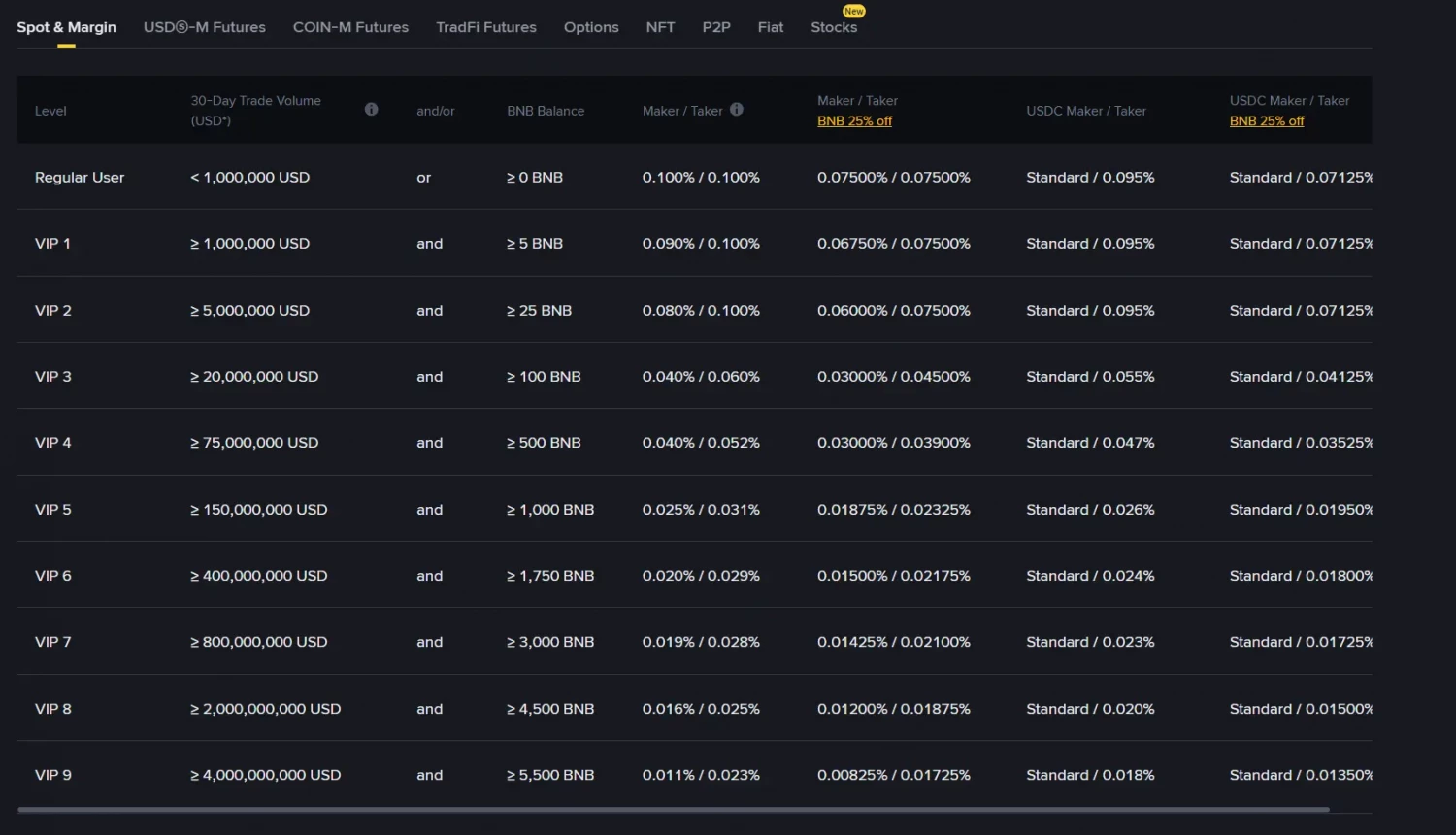
Fees are where Binance genuinely excels. The base rate of 0.1% for spot trading matches the industry standard, but multiple discount layers can push your effective rate well below competitors.
Spot Trading Fees by VIP Tier
| VIP Level | 30-Day Volume (USD) | Maker Fee | Taker Fee |
|---|---|---|---|
| Regular | < $1M | 0.100% | 0.100% |
| VIP 1 | ≥ $1M | 0.090% | 0.100% |
| VIP 2 | ≥ $5M | 0.080% | 0.100% |
| VIP 3 | ≥ $20M | 0.040% | 0.060% |
| VIP 4 | ≥ $75M | 0.040% | 0.052% |
| VIP 5 | ≥ $150M | 0.025% | 0.031% |
Most retail traders stay at the Regular tier, paying 0.1% per trade. That's $1 per $1,000 traded — reasonable but not the lowest available.
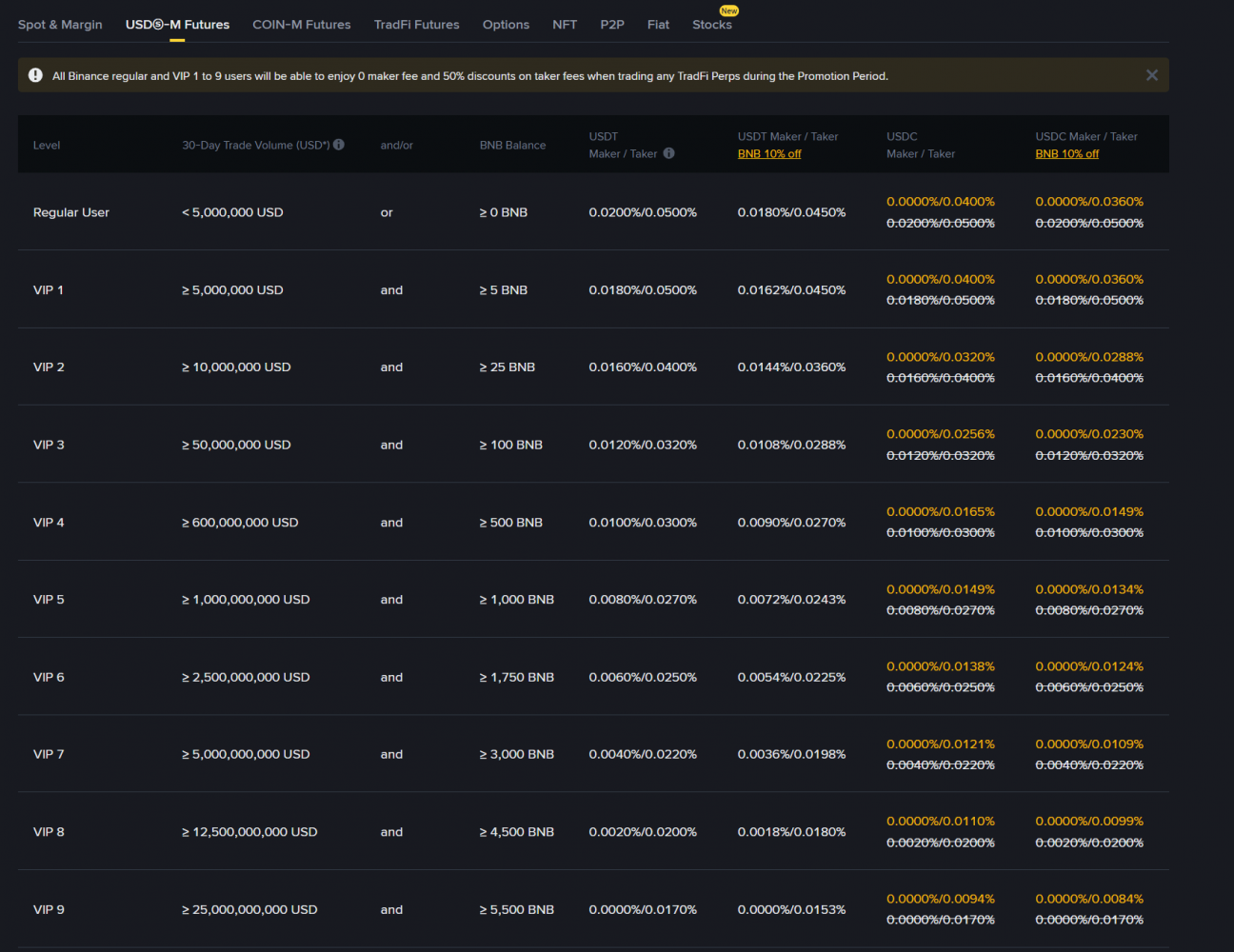
Futures Trading Fees
| VIP Level | USDT-M Maker | USDT-M Taker | USDC-M Maker | USDC-M Taker |
|---|---|---|---|---|
| Regular | 0.020% | 0.050% | 0.018% | 0.045% |
| VIP 1 | 0.016% | 0.040% | 0.014% | 0.036% |
| VIP 2 | 0.014% | 0.035% | 0.013% | 0.032% |
| VIP 3 | 0.012% | 0.032% | 0.011% | 0.029% |
Futures fees are significantly lower than spot — a standard taker pays 0.05% compared to 0.1% on spot. For high-volume futures traders, VIP tiers can bring maker fees down to zero at the top levels.
BNB Fee Discount — How to Stack Savings
Holding BNB (Binance's native token) and enabling "Pay fees with BNB" in your settings unlocks additional discounts that multiply with other reductions.
BNB discount rates:
| Product | BNB Discount |
|---|---|
| Spot Trading | 25% off |
| Futures (USDT-M) | 10% off |
| Margin Interest | 5% off |
Example calculation for spot trading:
Starting rate: 0.100% → After 25% BNB discount: 0.075% per trade
Combined with a referral code (20% off): 0.080% → Plus BNB discount (25%): ~0.060%
For someone trading $50,000 monthly, that's roughly $30/month in fees versus $50/month at the base rate — a saving of $240 per year.
Withdrawal Fees
Withdrawal fees depend on the cryptocurrency and network chosen:
| Asset | Network | Approximate Fee |
|---|---|---|
| BTC | Bitcoin | 0.0002-0.0005 BTC |
| ETH | ERC-20 | 0.003-0.005 ETH |
| USDT | TRC-20 | 0.2-1 USDT |
| USDT | BEP-20 | ~0.29 USDT |
| USDT | ERC-20 | 5-10 USDT |
Tip: Always choose the cheapest network when withdrawing. TRC-20 and BEP-20 are typically the most affordable for stablecoins.
How Binance Fees Compare to Competitors
| Exchange | Spot Taker | Futures Taker | Native Token Discount |
|---|---|---|---|
| Binance | 0.10% | 0.05% | 25% (BNB) |
| OKX | 0.10% | 0.05% | Up to 40% (OKB) |
| Bybit | 0.10% | 0.055% | VIP-based |
| KuCoin | 0.10% | 0.06% | 20% (KCS) |
| Coinbase | 0.40-0.60% | N/A | None |
| Kraken | 0.25-0.40% | 0.05% | None |
| MEXC | 0.05% | 0.02% | Up to 50% (MX) |
Binance is among the cheapest major exchanges. Only MEXC consistently undercuts on fees, but MEXC lacks Binance's liquidity and regulatory standing.
Trading Products Available on Binance
Binance offers virtually every type of crypto trading product. Here's what the platform provides and who each product is for.
Spot Trading
The core product. Buy and sell 490+ cryptocurrencies at market prices across 1,889+ trading pairs. The interface offers two modes: "Lite" for beginners (simplified buy/sell) and "Pro" for experienced traders (full order book, charting tools, advanced order types).
Futures Trading
Trade perpetual contracts with up to 125x leverage on Bitcoin and major pairs. Binance offers over 530 futures contracts across USDT-margined, COIN-margined, and USDC-margined products. This is Binance's highest-volume product, regularly exceeding spot volume.
Risk warning: Futures trading with leverage can result in rapid, total loss of your position. Most retail traders lose money on leveraged products. Start with low leverage (2-5x) if you're learning.
Margin Trading
Borrow funds to amplify spot positions with up to 10x leverage across 1,400+ pairs. Available in both isolated margin (risk limited to one position) and cross margin (shared across positions) modes.
Options Trading
European-style options on Bitcoin with defined expiry dates. More limited than futures but useful for hedging strategies.
Copy Trading
Follow successful traders and automatically replicate their positions. Set your own risk parameters, position sizes, and stop-losses. A relatively new addition that makes Binance more accessible to beginners who want market exposure without active trading.
Trading Bots
Built-in automated strategies including Spot Grid, Futures Grid, DCA (Dollar-Cost Averaging), Rebalancing, Arbitrage, and TWAP bots. No coding required — select parameters and the bot executes automatically.
P2P Trading
Buy and sell crypto directly with other users using local payment methods. Binance acts as escrow. Zero trading fees for the buyer. Available in most regions with local currency support.
Binance Earn: Staking and Passive Income
Binance Earn aggregates all passive income products into one section. Options range from low-risk savings to high-risk yield farming.
Key products and approximate yields:
| Product | Example APY | Risk Level | Lock Period |
|---|---|---|---|
| Flexible Savings (USDT) | ~10%+ | Low-Medium | None (withdraw anytime) |
| Flexible Savings (BTC) | 0.25-0.27% | Low | None |
| Flexible Savings (ETH) | 2.45-3.5% | Low | None |
| Locked Staking | Up to 100%+ | Medium | 30-120 days |
| ETH Staking | 3-5% | Low-Medium | Liquid via WBETH |
| Dual Investment | Up to 200% APY-equiv | High | Fixed term |
The catch with high yields. Products showing 100%+ APY typically involve new tokens with high inflation rates or are time-limited promotions. Sustainable yields on major assets (BTC, ETH, stablecoins) generally range from 1-10%. Approach anything higher with skepticism.
ETH Staking is noteworthy — you stake ETH and receive WBETH tokens that can be used elsewhere on the platform while your ETH earns staking rewards. Minimum is just 0.001 ETH.
Binance Launchpad and Launchpool
Two of Binance's most popular features for discovering new cryptocurrency projects.
Launchpad is Binance's token sale platform. New projects sell tokens at a fixed price to BNB holders. Over 100 projects have launched this way, raising more than $184 million collectively. Historical average ROI for Launchpad participants has been significant, though past performance doesn't guarantee future results.
Launchpool lets you stake BNB, FDUSD, or USDC to earn new tokens for free. No purchase necessary — you simply lock your existing tokens and receive new project tokens as rewards over a farming period. Your staked tokens are returned in full afterward.
Both products require holding BNB, which creates organic demand for the token beyond just fee discounts.
Is Binance Safe? Security Analysis
Security is the most critical factor when choosing an exchange. Binance has both strengths and a notable incident in its history.
Security Infrastructure
Binance employs institutional-grade security measures including cold storage for the vast majority of user funds, multi-signature requirements for withdrawals, real-time risk monitoring with AI-powered detection, and regular third-party security audits. Users can protect their accounts with two-factor authentication (Google Authenticator or SMS), an anti-phishing code for identifying legitimate emails, a separate trading password, withdrawal address whitelists, and login activity notifications.
The 2019 Hack
On May 7, 2019, hackers stole 7,000 BTC (approximately $40.7 million) from Binance's hot wallet. This represented about 2% of Binance's total BTC holdings at the time. Binance covered all user losses entirely from the SAFU fund. No user lost a single dollar. The exchange suspended deposits and withdrawals for one week while implementing enhanced security measures.
This remains the only successful hack in Binance's history. No further security breaches have resulted in loss of user funds since 2019.
SAFU Fund (Secure Asset Fund for Users)
Binance maintains a $1 billion emergency insurance fund to protect users against potential losses from security breaches or system failures. The fund is built by allocating 10% of all trading fees. If the fund drops below $800 million, Binance replenishes it back to $1 billion.
As of January 2026, Binance is converting the SAFU fund from USDC to 100% Bitcoin. This is the largest user protection fund in the cryptocurrency industry.
Proof of Reserves
Binance publishes cryptographic Proof of Reserves (PoR) showing they hold sufficient assets to cover all user deposits. The system uses Merkle Tree hashing combined with zk-SNARK proofs, allowing individual users to verify their balances are included. Total user assets held: approximately $162.8 billion across 45 crypto assets. Binance maintains zero debt in its capital structure, and corporate holdings are kept on a separate ledger from user funds.
Regulatory Status and the DOJ Settlement
Binance's regulatory story is the most complex in crypto. Understanding it helps you assess the platform's future stability.
The $4.3 Billion DOJ Settlement (November 2023)
In November 2023, Binance pleaded guilty to three charges: conspiracy to violate the Bank Secrecy Act, operating an unlicensed money transmitting business, and willful violation of sanctions laws. The total settlement included $2.5 billion in forfeiture plus $1.8 billion in criminal fines to the DOJ, $968 million to OFAC for sanctions violations, and $2.85 billion to the CFTC.
As part of the agreement, Binance must operate under an independent compliance monitor appointed by FinCEN for five years. The US Treasury retains access to Binance's systems during this period.
What this means for users. Ironically, the settlement arguably makes Binance safer than before. The exchange now operates under more regulatory oversight than almost any other crypto platform. The compliance requirements are extensive and enforced by US government monitors.
Current Licenses Worldwide
| Jurisdiction | License Type | Status |
|---|---|---|
| Dubai (VARA) | Full VASP | ✅ Active (March 2024) |
| Abu Dhabi (ADGM) | Full Global Platform | ✅ Active (January 2026) |
| Bahrain | Category 4 + BPay | ✅ Active |
| Japan | JFSA Crypto Exchange | ✅ Active (spot only) |
| France | DASP Registration | ⚠️ Under review |
| India | FIU-IND | ✅ Registered |
| Indonesia | PFAK (via Tokocrypto) | ✅ Active |
| Argentina | VASP | ✅ Active |
EU MiCA Status
Binance filed its MiCA (Markets in Crypto-Assets) license application with Greece's HCMC in January 2026. The regulatory deadline for compliance is July 1, 2026. As of February 2026, 53 firms have already received MiCA licenses (including Coinbase, Kraken, OKX, and Robinhood), while Binance has not yet been approved.
This is worth watching. Operating without MiCA after the deadline could restrict Binance's European services.
Where Binance Is and Isn't Available
Binance serves most of the world, but several major markets are blocked or restricted.
Completely blocked (Binance.com): United States, Canada, Iran, Cuba, North Korea, Syria, Crimea/Russian-occupied Ukraine.
Partially restricted: United Kingdom (no FCA approval; lending and staking unavailable), Australia (futures halted by ASIC), Japan (spot only, no derivatives), Nigeria (operations suspended; $81.5B lawsuit pending), and India (high taxes limit services).
Full access: Most of Europe (pending MiCA), Asia (excluding restricted countries), Africa, South America, Middle East, and Oceania.
Binance.US — The American Version
US residents cannot use Binance.com. Instead, they must use Binance.US, a separate legal entity with significant differences.
| Feature | Binance.com (Global) | Binance.US |
|---|---|---|
| Cryptocurrencies | 490+ | ~160 |
| Futures Trading | Yes (125x) | No |
| Margin Trading | Yes | No |
| Staking Products | Full suite | Limited |
| Fee Structure | Lower | Higher |
Binance.US state availability. Even within the US, Binance.US is unavailable in Hawaii, Idaho, Louisiana, New York, Texas, Vermont, and the US Virgin Islands.
The SEC lawsuit against Binance.US was dismissed with prejudice on May 29, 2025, removing a major legal overhang for American users.
Binance Mobile App and Desktop Platform
Binance offers apps across all major platforms.
Mobile app (iOS and Android): Rated 4.8/5 on iOS (9,700+ reviews) and 4.7/5 on Google Play (3.5+ million reviews). The app includes every feature available on the web — spot trading, futures, earn products, P2P, and wallet management. A "Lite" mode simplifies the interface for beginners.
Desktop app: Available for Windows and macOS with the same full feature set. Slightly faster execution than the web interface for active traders.
Web platform: Accessible at binance.com without any download. Includes TradingView charts, real-time order books, and all trading tools.
Web3 Wallet: Binance's built-in self-custody wallet uses MPC (Multi-Party Computation) security — no seed phrase required. Integrates with 29 DEXs and 15 bridges, letting you access decentralized finance directly from the Binance app.
Deposit and Withdrawal Methods
Multiple ways to fund your Binance account, each with different costs and processing times.
Deposit Methods
| Method | Fees | Processing Time |
|---|---|---|
| Crypto transfer | Free | Minutes to ~1 hour |
| SEPA bank transfer | Free or minimal | 1-3 business days |
| Credit/Debit card | ~2% | Instant |
| P2P Trading | 0% buyer fees | Instant (manual process) |
Minimum deposits. No minimum for cryptocurrency deposits. Fiat deposits require approximately €15 minimum for cards and ~$50 for bank transfers.
Choosing the Right Deposit Method
For your first deposit, crypto transfer is the cheapest option if you already hold crypto elsewhere. Simply send from your existing wallet to your Binance deposit address. Make sure you select the correct network — sending tokens on the wrong network results in permanent loss.
Card purchases work for complete beginners who don't yet own crypto. The 2% fee is a fair trade-off for instant availability and simplicity.
P2P trading offers the most payment flexibility, supporting bank transfers, mobile payments, and local methods. Zero buyer fees make it attractive, but the process requires manual interaction with a seller.
Customer Support
Customer support is Binance's weakest area based on user feedback.
Available channels: 24/7 live chat (AI chatbot with human escalation), email support at support@binance.com (12-24 hour response typical), phone support at 1-844-900-1450 (limited), and an extensive self-help knowledge base. Support is available in approximately 40 languages.
The reality. Binance's Trustpilot rating hovers around 1.6/5 stars. Common complaints include slow response times, difficulty reaching human agents past the chatbot, extended account verification delays, and withdrawal holds requiring additional documentation. These issues are not unique to Binance — most large exchanges face similar support challenges at scale. But with 300+ million users, the volume of support requests inevitably leads to longer wait times and less personalized service.
Tip: The in-app live chat generally resolves issues faster than email. For account-specific problems, have your verification documents ready before contacting support.
Binance Pros and Cons
Strengths:
Binance offers the deepest liquidity in the market, meaning better price execution on large orders and minimal slippage. The fee structure is among the lowest, especially with BNB discounts and VIP tiers stacked together. With 490+ cryptocurrencies and nearly 1,900 trading pairs, the selection is the largest among regulated exchanges. The product range is unmatched — from basic spot trading to futures, options, earn products, launchpad, NFTs, and Web3. The $1 billion SAFU fund provides the industry's strongest user protection guarantee. The mobile app is polished and feature-complete. And the Proof of Reserves system offers transparency that many competitors lack.
Weaknesses:
The $4.3 billion DOJ settlement and CZ's guilty plea raise legitimate concerns about past corporate governance. Customer support quality remains below what you'd expect from the world's largest exchange. The interface complexity can overwhelm beginners despite the Lite mode. US users are stuck with the significantly limited Binance.US platform. Pending MiCA approval creates uncertainty for European users. And some regions face service restrictions or complete blocks.
Who Is Binance Best For?
Ideal for: Active traders who prioritize low fees and deep liquidity, cryptocurrency enthusiasts who want access to a wide variety of coins and trading products, futures and margin traders who need high leverage and diverse contract options, passive investors looking for staking and earning yields, and users interested in early access to new projects through Launchpad and Launchpool.
Not ideal for: Complete crypto beginners who may find the interface overwhelming (consider Coinbase for simplicity), US residents who need full exchange features (Binance.US is limited), users in restricted countries, and traders who prioritize regulatory certainty above all else.
Frequently Asked Questions
Is Binance safe to use in 2026?
Binance maintains institutional-grade security with a $1 billion SAFU fund, cold storage for user assets, proof of reserves, and comprehensive 2FA protections. The only hack (2019, $40.7M) was fully covered with zero user losses. The ongoing DOJ compliance monitor adds an additional layer of oversight.
What are Binance trading fees?
Base spot fees are 0.1% maker/taker. Futures fees start at 0.02% maker and 0.05% taker. Fees decrease with higher VIP levels based on 30-day trading volume. Using BNB for fee payment provides an additional 25% discount on spot trades.
How do I register on the Binance site?
Visit binance.com, click "Sign Up," enter your email and password, optionally enter a referral code (47269192 for 20% off fees), complete verification, and confirm your email. The entire registration process takes about 5 minutes.
Is Binance available in the United States?
Binance is not available to US residents. Americans must use Binance.US, a separate platform with fewer cryptocurrencies (~160 vs 490+), no futures trading, and limited features. Binance.US is also unavailable in New York, Texas, Hawaii, Idaho, Louisiana, and Vermont.
What is the Binance SAFU fund?
The Secure Asset Fund for Users is a $1 billion emergency fund that covers losses from security breaches or system failures. It's funded by 10% of all trading fees and is currently being converted to Bitcoin.
Can I use Binance without KYC verification?
No. As of 2026, Binance requires identity verification for all account functionality including trading, deposits, and withdrawals. You need a government ID and selfie to complete verification.
How does Binance compare to Coinbase?
Binance offers significantly lower fees (0.1% vs 0.4-0.6%), more cryptocurrencies (490+ vs 200-300), futures trading, and advanced products. Coinbase is easier to use for beginners and is fully regulated in the US. For cost-conscious traders, Binance wins. For regulatory comfort and simplicity, Coinbase wins.
What happened with CZ and the DOJ settlement?
In November 2023, CZ resigned as CEO and pleaded guilty to violating the Bank Secrecy Act. Binance paid $4.3 billion in penalties. CZ served 4 months in prison and received a presidential pardon from Trump in October 2025. Richard Teng now serves as CEO.
Does Binance have a referral program?
Yes. New users can enter a referral code during registration for permanent fee discounts. Existing users earn commissions when referred users trade. See our Binance referral code page for details.
What is Binance Proof of Reserves?
Binance publishes cryptographic proof that they hold sufficient assets to cover all user deposits. The system uses Merkle Trees and zk-SNARK proofs. Users can individually verify their balances are included. Total verified user assets: approximately $162.8 billion.
Final Verdict
Binance remains the most comprehensive cryptocurrency exchange available in 2026. The combination of lowest-tier fees, deepest liquidity, 490+ cryptocurrencies, and the broadest product suite makes it the default choice for serious crypto traders.
The regulatory history demands attention — the $4.3 billion DOJ settlement was the largest in crypto history. But the resulting compliance framework, combined with the $1 billion SAFU fund, Proof of Reserves transparency, and ongoing government oversight, arguably makes Binance more accountable than it was before.
What to do next: If Binance is available in your region and you're comfortable with the exchange's risk profile, registration takes five minutes. Enter referral code 47269192 during sign-up for a 20% lifetime discount on spot trading fees, then complete KYC verification and enable 2FA immediately.
For users in the US, explore Binance.US or consider alternatives like Coinbase or Kraken that operate with full US regulatory approval.
For referral codes on other exchanges, visit our crypto promo codes page including OKX, Bybit, KuCoin, MEXC, and more.