Updated
Sep 06, 2026
Updated
Sep 06, 2026
 8 min read
 Checked regularly
Three different products, and the names don't help
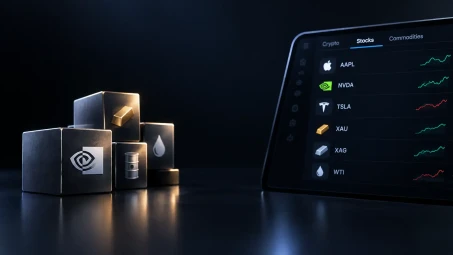
The exchanges don't agree on a label. Bitget calls them RWA contracts, Bybit and Binance call them TradFi perpetuals, OKX splits them into equity and commodity. Behind those names sit three unlike products, and confusing them costs money.
- Tokenized stocks. Tokens that give you exposure to real shares. Depending on the issuer they may be backed 1:1 by the underlying, but backing doesn't mean the holder gets shareholder rights.
- Stock perpetual futures. There's no share underneath at all. It's a contract on the price difference, with leverage, funding and liquidation risk. You own nothing and there's nothing to redeem. Bybit's own documentation describes its TradFi perpetuals as CFD products tracking the underlying price, so on that venue "perp" and "CFD" are two labels for the same idea.
- Commodity and currency contracts. Gold, silver, oil, forex, indices. Derivatives again, except for spot pairs like XAUT/USDT — a token backed by physical gold. Some venues run these as a separate CFD platform with its own pricing: Bybit charges per lot rather than per cent, $6 a lot on forex and metals, $0.02 a lot on US stock CFDs, with leverage from 500:1 on forex down to 5:1 on stocks.
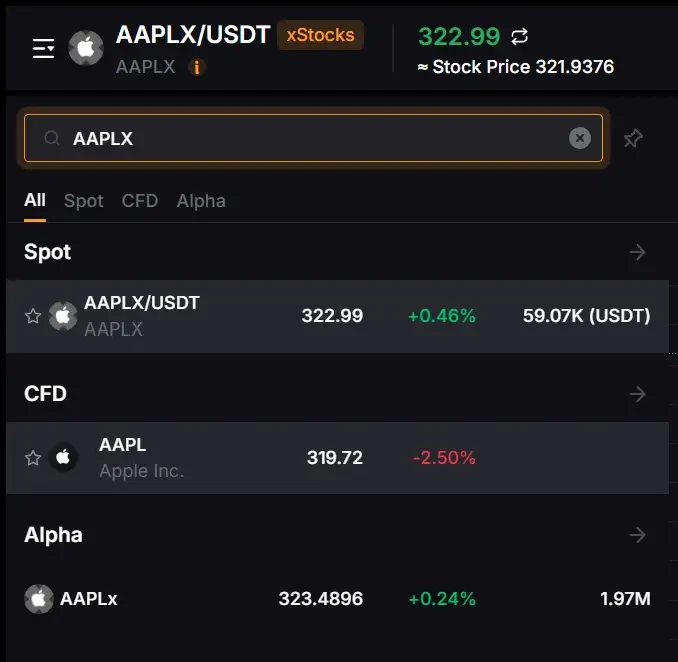
Search a ticker and you'll see all of this in one screen. Apple comes up on Bybit as AAPLX on spot, as an AAPL CFD, and again on Alpha — three products, three prices, roughly a percent apart. Which one you click decides whether you hold something backed by a share, a contract on its price, or something else entirely.
The difference is practical. A tokenized stock can reflect dividends and, with some issuers, be held off the exchange. A leveraged perp gets liquidated on a drawdown the token holder would simply have sat through.
What you own, and what you don't
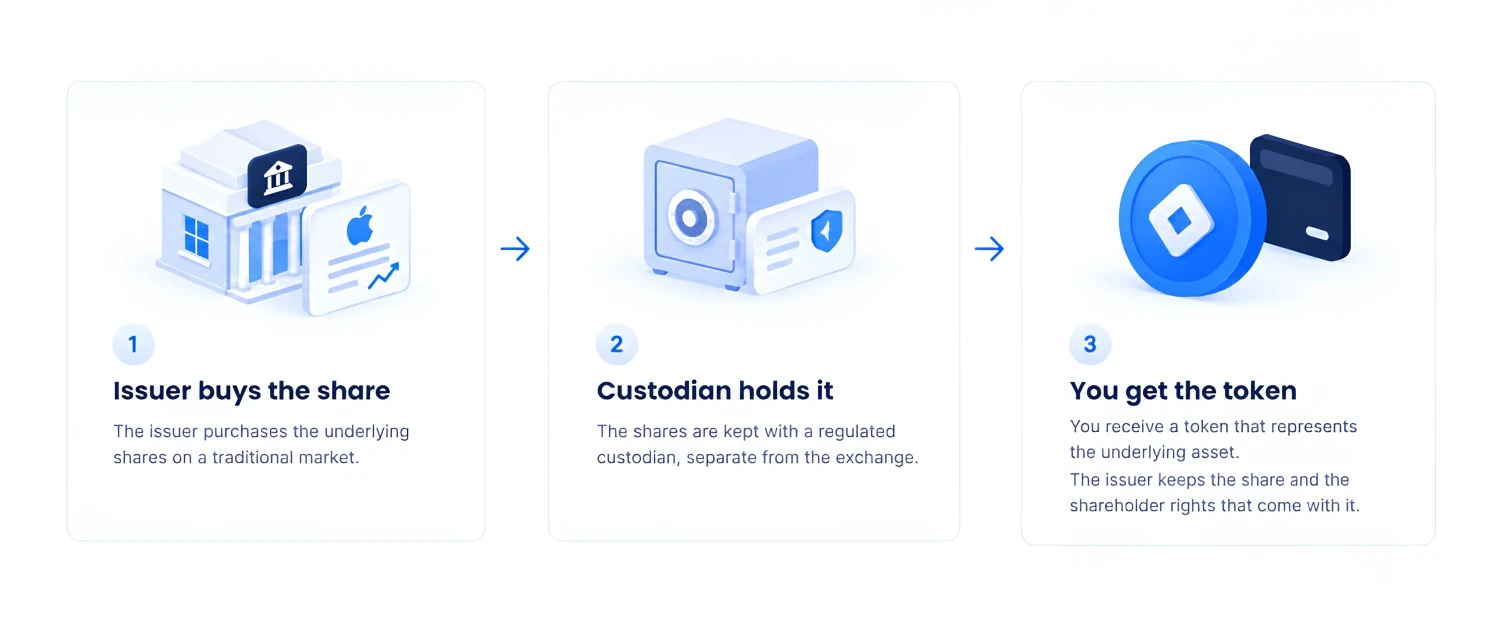
For custodial tokenized stocks the structure is straightforward: an issuer buys the underlying shares, holds them with a custodian and mints tokens against them. What the holder legally owns, though, depends on the product — you may have an economic claim on the asset without the shareholder rights attached to the stock itself.
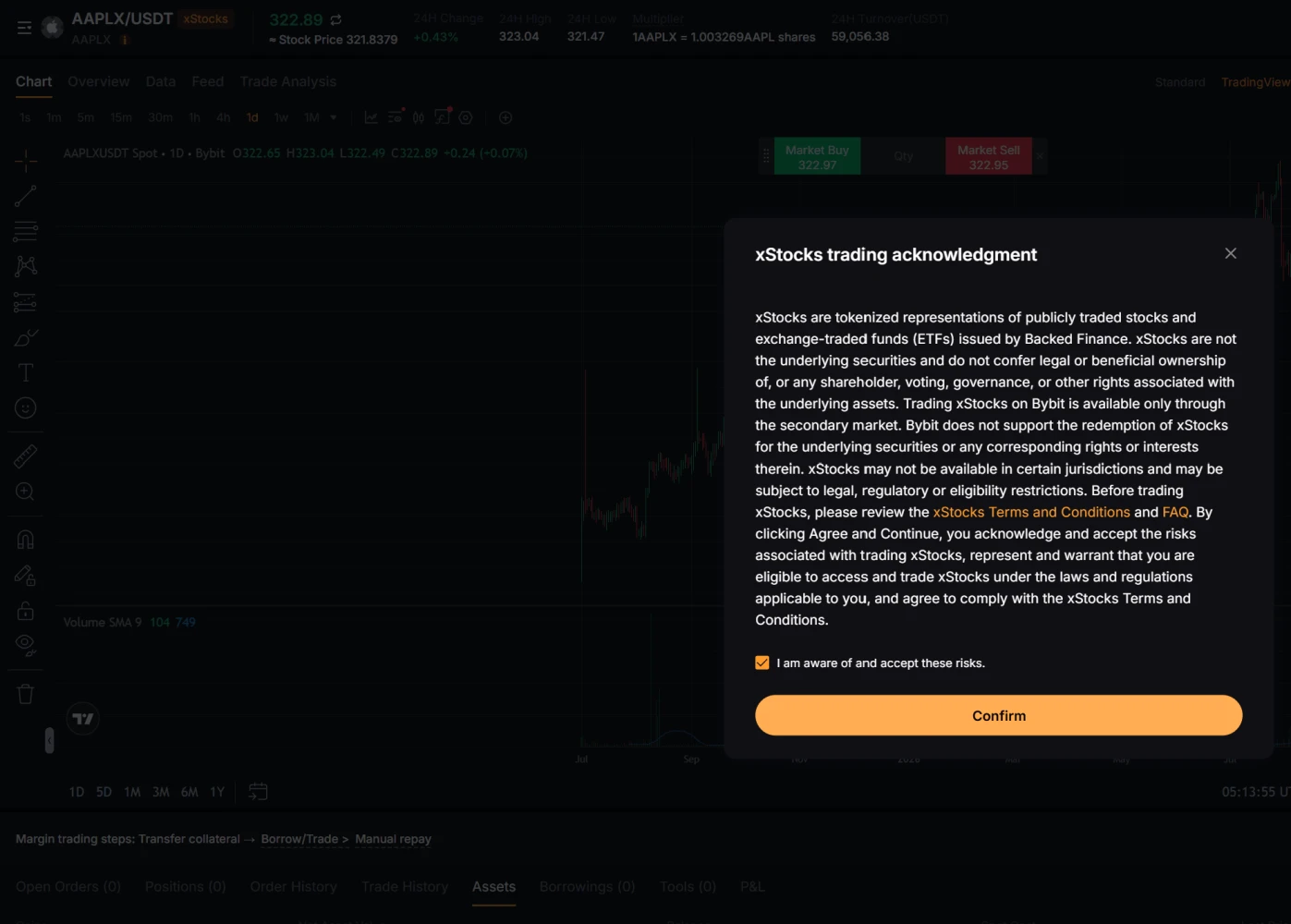
The exchanges say this themselves. Bybit's trading dialog states that xStocks are not the underlying securities and confer no legal or beneficial ownership, no voting and no governance rights.
What follows from that.
- Usually no direct vote. Voting rights generally stay with the issuer holding the underlying stock. Ondo added proxy voting through Broadridge for 250+ tokenized stocks in April 2026, but under their own terms that's a right to express a preference to the issuer, and the issuer still casts the vote.
- Redemption isn't universal. OKX lets you withdraw supported tokens to your own wallet through Solana and X Layer. Bybit states plainly that it doesn't support redeeming xStocks for the underlying securities — you can buy and sell, and that's the whole set of actions available.
- Corporate actions are handled for you, but not painlessly. When an underlying stock splits, Bybit suspends trading on the pair for around 30 minutes, cancels every open order including take-profits and stop-losses, freezes positions so you can't open or close, then rewrites your position size and average entry price by the split factor. Any fraction that doesn't divide evenly is settled out and booked as PnL. Trading bots keep their positions but not their parameters, so a bot left running after a split trades on numbers that no longer match the contract.
- Protection works differently from a brokerage account, and depends on the issuer, the custodian and the jurisdiction. Familiar compensation schemes and dispute rules may not apply — check what's stated for your specific product.
The US is generally excluded from the products covered here.
One exception worth watching is Coinbase. In June it announced tokenized stocks structured around direct ownership rather than exposure — in Brian Armstrong's words, current solutions are "some form of derivative or IOU, not real ownership." Check the product's current status and terms before relying on that. The market is moving from exposure toward genuine tokenized securities, but today most products are still exposure.
Dividends: look at the issuer, not at the label
Dividends depend on the issuer and the product structure, not on the word "tokenized." There are at least three mechanics in use.
- Direct payment. Bitget states dividends are credited directly to rToken holders. Binance ran a cash payout on MUB, its tokenized Micron share, in July 2026: a snapshot of holders on 6 July, $0.15 per token on 21 July, processed entirely through the tokenized product.
- A growing multiplier. Bybit's xStocks don't pay out separately. Instead the token's claim grows: one AAPLX now equals 1.003269 Apple shares, so the dividend shows up as a larger entitlement per token rather than as cash.
- An account adjustment. On CFDs the dividend is credited to long positions and debited from short ones, sized by your position. It isn't a dividend, it's compensation for the effect the payout has on the price.
Stock perpetuals pay nothing at all: there's no share underneath.
One detail almost nobody writes about: put a tokenized stock into a smart contract that doesn't implement the issuer's hook, and the dividend goes to the contract address. It's recoverable, but it's a separate piece of work.
Who offers what
Methodology: contract counts come from a tally of each exchange's contract API on 1 September 2026. Tokenized spot stocks aren't in that figure and sit in a separate column.
| Exchange | RWA perpetuals | Share of all perps | Tokenized stocks | Metals & commodities |
| Bitget | 304 of 769 | 39.5% | rToken, 500+ names | Gold, silver, oil, forex, indices |
| Bybit | 224 of 740 | 30% | xStocks, no redemption | Perps + separate CFD platform |
| Binance | 180 | — | Yes, with a cash payout | Perps available |
| OKX | 168 | — | xStocks, withdrawal via Solana and X Layer | Brent and WTI with ICE |
| KuCoin | 139 | — | — | Perps available |
Bitget has the broadest offering in this comparison by contract count: 304 perpetual contracts, a dedicated rToken product with dividends and automated corporate actions, plus Stock+ with access to 10,000+ securities. According to Bitget, rToken reached $114 million in assets and $671 million in cumulative volume by July.
OKX stands out for its xStocks integration: tokenized stocks trade on spot around the clock, and supported tokens can be deposited and withdrawn through Solana and X Layer. Its partnership with ICE, the parent company of the NYSE, is a separate development worth watching.
Fees
Base spot rates: OKX charges 0.08% maker and 0.10% taker, Bybit a flat 0.10%. Bitget applies its standard 0.1% spot schedule to stock tokens; the 0.05% promo ran through 31 August 2026 and has ended.
On perps: OKX and Binance 0.02%/0.05%, Bybit 0.02%/0.055%.
Holding overnight costs extra on CFDs. Bybit charges a swap fee on every position held past server midnight — by points on forex, metals and oil, by money on indices, by percentage on US stock CFDs. On Wednesdays it's charged triple to cover the weekend. On a leveraged position held for weeks, the swap can outweigh the commission that got you in.
Fees aren't the whole cost either. Outside the underlying's regular market hours the price moves less and liquidity thins out. At weekends some symbols go reduce-only: you can close a position but not open or add to one. Bitget opened 24/7 trading for 20 popular rTokens only; the rest trade during market hours.
What to do if you want to start
- Pick the product first. Want to hold a position for months and collect dividends? Look at tokenized stocks on Bitget or Binance. Want to trade the price move with leverage? That's what perps are for. Don't mix them: different instruments, different risk.
- Check availability in your country. The products aren't available in the US, and elsewhere the list depends on jurisdiction and verification level. Work this out first, not last.
- Start small and during market hours. At night and at weekends the spread is wider, and on a thin name you'll lose more to it than to the fee.
- Do the tax math. In most jurisdictions selling a tokenized share is the same taxable event as selling an ordinary one. This isn't tax advice — check your own rules before the first trade.
Where this loses to a broker
Regulatory uncertainty. The SEC has signalled it may create tailored exemptions letting platforms offer tokenized equities without full broker-dealer registration. Nothing is settled, and rules of that kind can be revised — for a long-term holder that's residual risk.
Liquidity. Volumes are growing fast, but this is still around a billion dollars against trillions on conventional exchanges. On popular names you won't feel the difference. On thin ones you'll feel it immediately.
No shareholder rights. If voting, reporting and investor protection matter to you, most of today's tokens won't provide them. They provide the price, and that's it.
Issuer dependency. With an ordinary share the main risk sits with the company. With a tokenized instrument you add the token issuer, the custodian and the venue's infrastructure. Three links instead of one.