Updated
Sep 09, 2026
Updated
Sep 09, 2026
 6 min read
 Checked regularly
What actually happened
Robinhood Chain launched on July 1 as an Ethereum L2 built on Arbitrum. Gas is paid in ETH. The public testnet went live on February 10.
The September 3 figures from Johann Kerbrat, Robinhood's GM of crypto: $34.6 billion in DEX volume, 190-plus stock tokens with over $3 billion in cumulative volume, 576 million transactions, 12.3 million addresses, and another $7.29 billion routed through perps on Lighter.
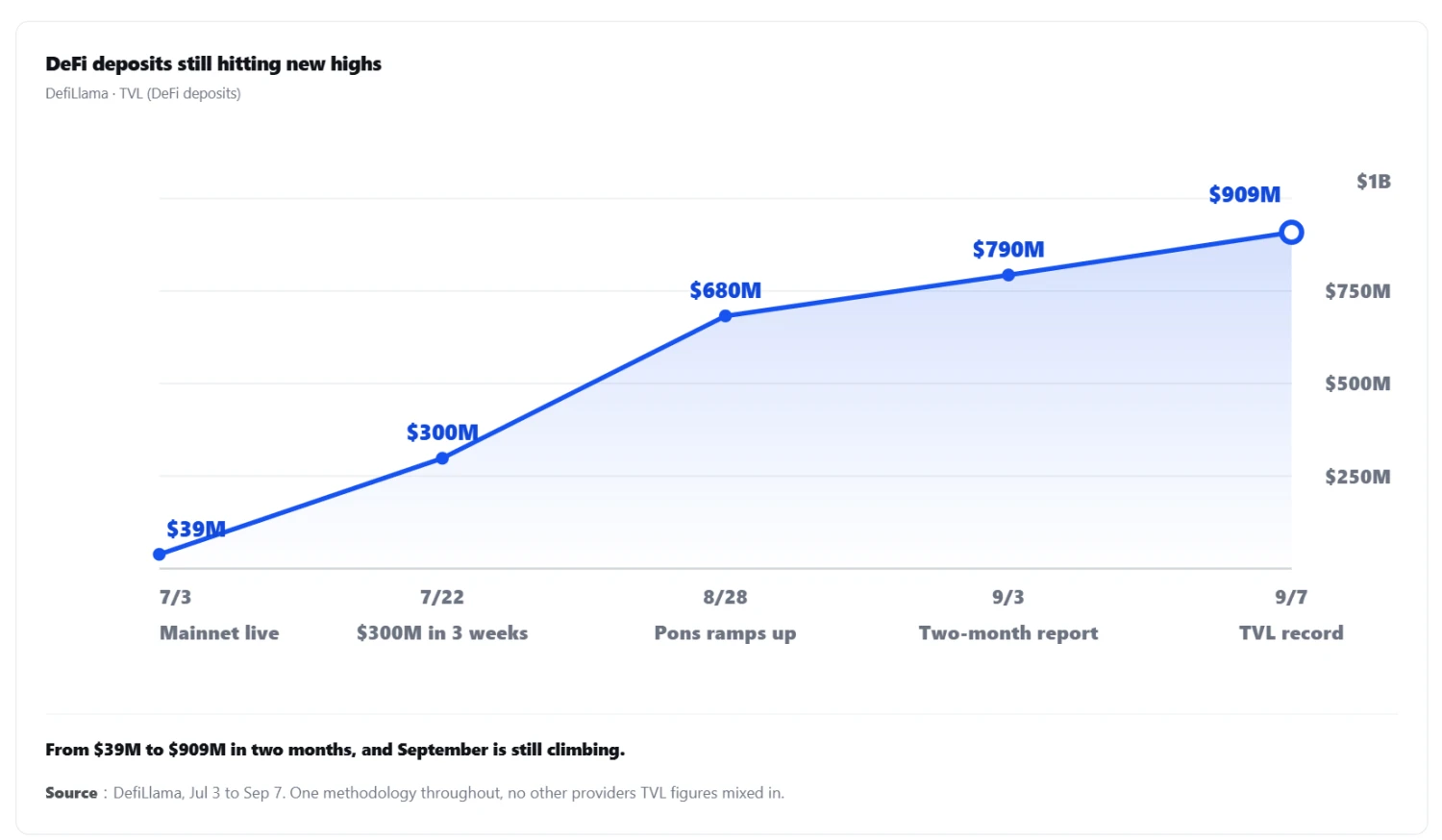
One caveat on the numbers. Robinhood puts "protocol TVL" at $1.27 billion, while DefiLlama on the same date shows $791 million on the chain and $2.78 billion bridged. Robinhood hasn't published its methodology, so the two can't be reconciled. Everything below uses DefiLlama: one method across the whole period.
How a memecoin became a wrapper for a stock
The mechanic itself is the interesting part.
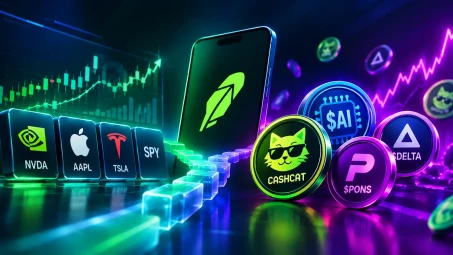
A memecoin normally trades against ETH or a stablecoin. On Robinhood Chain, services appeared that let you launch a meme with its liquidity pool denominated in a tokenized stock. Not in ETH, but in NVDA, AAPL, TSLA or SPY.
Buy CASHCAT and you touch a tokenized share through the pool: the meme trades against it rather than against ETH or a stablecoin. The meme becomes a speculative layer on top of the stock, with leverage the stock itself doesn't carry.
Tokenized stock volume went from under $500,000 a day to $8.1 million as a result. The tail started wagging the dog: memes began feeding liquidity into the exact product the chain was built for.
How this chain differs from Solana and Base
The difference isn't size. It's where the users come in from.
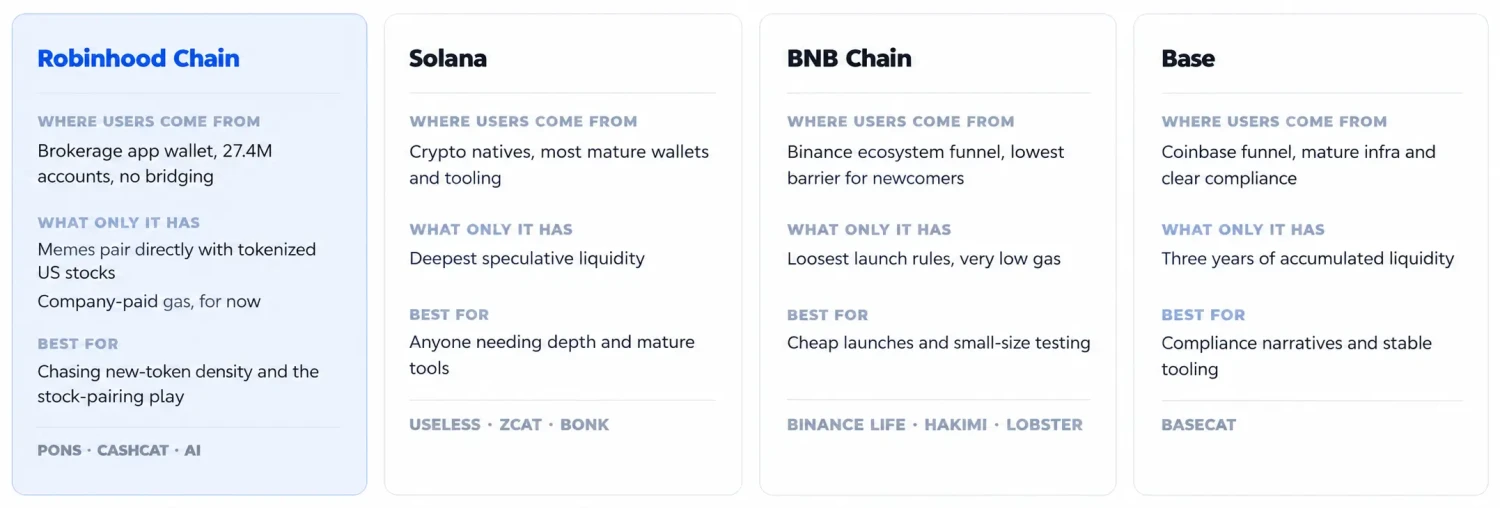
Solana draws crypto natives, with the most mature tooling and the deepest speculative liquidity. BNB Chain pulls its audience through the Binance ecosystem, with cheap gas and loose launch rules. Base feeds off Coinbase.
Robinhood brings people in from a brokerage app, skipping bridges and exchanges entirely. Robinhood has 27.4 million funded accounts — brokerage accounts, not chain addresses, but that's the funnel. And this is the only place I've found where memes trade paired with tokenized US stocks.
One more difference is temporary but decisive right now: the company pays the gas for users of its own wallet. Comparing raw activity across chains isn't meaningful until that stops.
Who's actually making money here
The players on this chain have very different economics, and it's worth telling them apart.
- Launchpads take a cut of every launch. Pons lets you mint a token for about a dollar, and on September 2 alone nearly 25,000 tokens appeared there. In early September a meme-minting app became one of the largest fee generators in all of crypto — roughly $5.95 million in 24 hours.
- Infrastructure earns on volume. Uniswap handled around 86% of the chain's 30-day DEX volume. The more that churns, the more it collects.
- Memes rise fastest and last shortest. Pure attention, no revenue, no dividends. CASHCAT — named after what Robinhood's founders nearly called the company back in 2010 — reached a $156 million market cap after climbing 2,158% in a week. The community launched it, not Robinhood; the broker only listed it in its own app on August 6. And $156 million is the peak, not today's number.
The gap between the first two and the third is fundamental: a fee is revenue, a meme's rise is somebody else's money arriving later.
What's dangerous to buy
Robinhood Chain has no token of its own. Gas is paid in ETH and no airdrop was ever announced. Anything calling itself an "official Robinhood Chain token" and promising an airdrop or a launch reward has nothing to do with the chain.
The second trap is subtler. Real tokenized stocks are issued by Robinhood's Jersey entity, with custody and a redemption channel. But anyone can deploy a contract with NVDA in its name in a matter of minutes, and it carries no legal link to the company at all. Read the contract, not the ticker.
And even with the real ones, you hold a claim on the issuer rather than the share: no voting rights, no dividends.
September 29 is the first honest test
Since launch, Robinhood has subsidised gas for Robinhood Wallet users. On September 4 the chain collected $4.59 million in fees, and that portion is paid by the company, not by users. The 90-day subsidy ends around September 29; Robinhood hasn't said what happens after.
Past that date it becomes visible how many people were using the chain and how many were using free gas. It's the one date in this article worth putting in a calendar: any verdict on the chain's staying power before then is premature.
The second test is Robinhood's Q3 results in late October, the first full quarter of mainnet. So far the chain hasn't been named as a material contributor in the accounts, and the stock trades at 47 times earnings — priced like a high-growth fintech, not a broker.
What this says about the crypto market
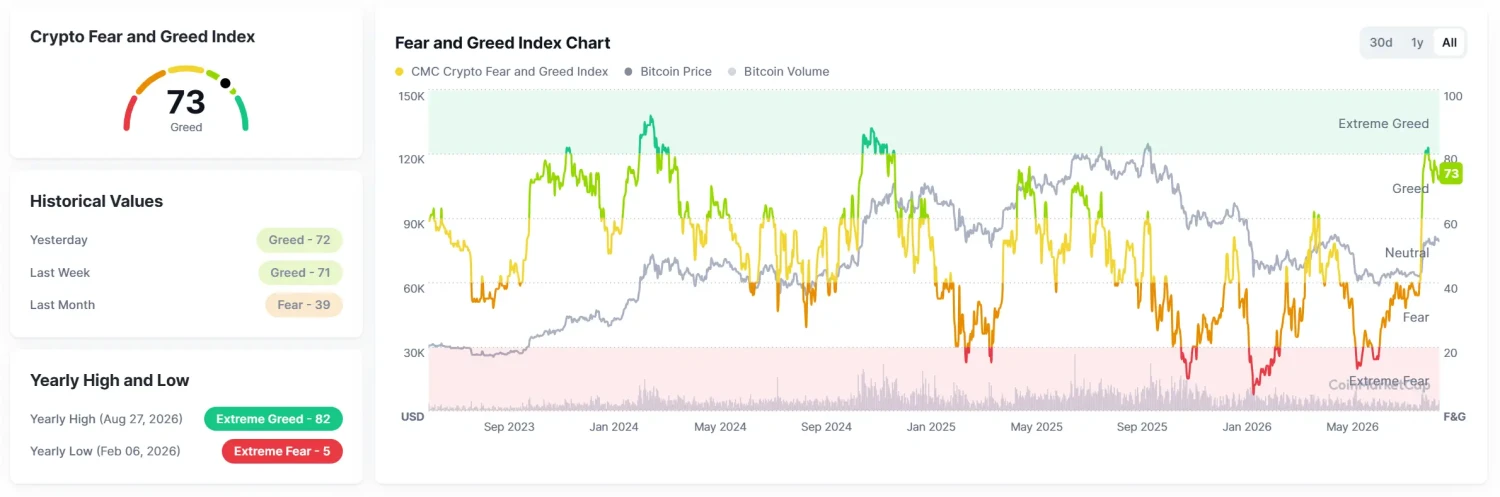
Bitcoin sits near $78,800 against its October 2025 peak of $124,677, down 37%. Money rotated into Bitcoin as the market fell, with dominance at 57.6%, which means retail sitting in altcoins is further down than that.
Meanwhile the Fear and Greed index reads 73 — greed. A month ago it read 39, fear. For scale: the yearly low was 5 on February 6, the yearly high 82 on August 27 — right in the middle of the memecoin run.
Greed on a market a third below its peak isn't a sign of recovery. It's what people look like when they're trying to win back what they lost, and leveraged memecoins on a new chain are exactly where that money goes.
So, does it last?
Two things the chain has already done, and they hold regardless of what happens to the memes.
It showed that tokenized stocks can be working liquidity rather than a display case. And it gathered 12.3 million addresses on infrastructure built for regulated settlement. Addresses, not users: one person can hold a dozen wallets.
The practical read, if you're looking at this now. Treat the chain as infrastructure and it's an interesting way into tokenized equities — and worth waiting until the end of September. Look at it as memes that went up 90x and you're looking at August's numbers while buying at September's prices, and the gap between those two things is the entire risk.
None of the chain's eleven largest tokens existed before July. And the main thing it hasn't proved: that this volume holds without the subsidy.